Open post

February Advocacy Report: Looking forward, working hard

by David Raskin, Friends Board President

We continue to wait for the U.S. Senate to confirm Acting Director Martha Williams as the new Director of the U.S. Fish and Wildlife Service (USFWS). We expect that after her confirmation, the Executive Review Board will act to appoint a successor to Regional Director Greg Siekaniec who retired last August. We also hope that a Special Assistant for Alaska will be appointed soon..


Arctic National Wildlife Refuge

The Budget Reconciliation bill that includes repeal of the Arctic National Wildlife Refuge oil and gas program and a buy-back of all existing leases seems doomed after Senators Manchin and Sinema failed to support the bill passed by the House. We are hopeful that a compromise version will eventually be approved, and the Arctic Refuge lease repeal will remain in a revised version of the legislation. This may not occur before summer, if at all. In the meantime, USFWS and Bureau of Land Management (BLM) have begun the lengthy and expensive process of developing the Supplemental Environmental Impact Statement (EIS) required by order of the Secretary. This is an unfortunate waste of scarce resources if it is ultimately rendered moot by repeal of the leasing program. The Alaska Industrial Development and Export Authority (AIDEA) filed suit to stop the process and was joined by the State. We anticipate that many conservation organizations will intervene on behalf of the government.

The threat to the Coastal Plain continues after the completion of the SF 299 application by Kaktovik Inupiat Corporation (KIC) for a winter right-of-way across the tundra in a wilderness study area. The validity of their claim that Kaktovik lands are an inholding without adequate and reasonable access must be decided by the Secretary in consultation with the Solicitor. If KIC prevails, there must be a notice of intent and a NEPA process. The significance of this effort by KIC is related to the Izembek application for a similar inholding right-of-way. If these questionable gambits succeed, it will make that process available for similar claims in other refuges and possibly all federal conservation units. That would be a disaster for all national conservation lands.

The contractor hired by the USFWS composed a draft of the results of its evaluation of the Kaktovik claim of historical vehicle use for subsistence activities in the Arctic Refuge tundra, including Wilderness study areas. However, they are waiting to receive additional evidence from the applicant to support their claim.
Award-winning Arctic Refuge Manager Steve Berendzen transfers on February 11 to manage a refuge complex in the Lower 48. He will be greatly missed for his outstanding work to protect the Arctic Refuge from the continuing threats of development and incursions into its pristine wilderness.

Izembek National Wildlife Refuge
There still is no word from the court since oral arguments were held before the Ninth Circuit Court of Appeals on August 4 concerning the defendants’ appeal of our second successful lawsuit that stopped the illegal land transfer for the proposed road. We also await a final decision by USFWS regarding the State’s appeal of the denial of helicopter use in the designated Wilderness. The findings by the Acting Regional Director in Anchorage have been sent to Acting USFWS Director Martha Williams and then to the Assistant Secretary and the Deputy Secretary. A decision probably will not be issued until Martha Williams is confirmed but we expect that the State’s appeal will be denied. Also, we have no word on plans for the Secretary of the Interior’s visit to King Cove.

Alaska Maritime National Wildlife Refuge
The comment period closed on the Bureau of Ocean Energy Management (BOEM) Draft Environmental Statement (DEIS) for the Lower Cook Inlet oil and gas development lease sale of approximately 1.09 million acres of seafloor from Kalgin Island in the north to Augustine Island in the south. The proposed developments would create drilling platforms and underwater pipelines, pose a high risk of oil spills, and greatly increase industrial transportation in Lower Cook Inlet that could seriously impact lands and wildlife.in the Maritime Refuge. We await the issuance of the EIS.

Other Refuges
We have no significant updates on Kenai Refuge regulations or Yukon Flats Refuge oil exploration in Doyon inholdings.

Sturgeon Decision
We are unaware of further action following the Supreme Court decision in Sturgeon v. Frost, 139 S. Ct. (1066) 2019. Based on this ruling and Alaska National Interest Lands Conservation Act (ANILCA) Sec. 103, the State of Alaska asserted primary jurisdiction over navigable waters on federal lands in Alaska.

Open post

An Eye to the Future: Stewarding the Kenai National Wildlife Refuge: Tuesday, 2/15, 5 – 6 p.m. (AKT)

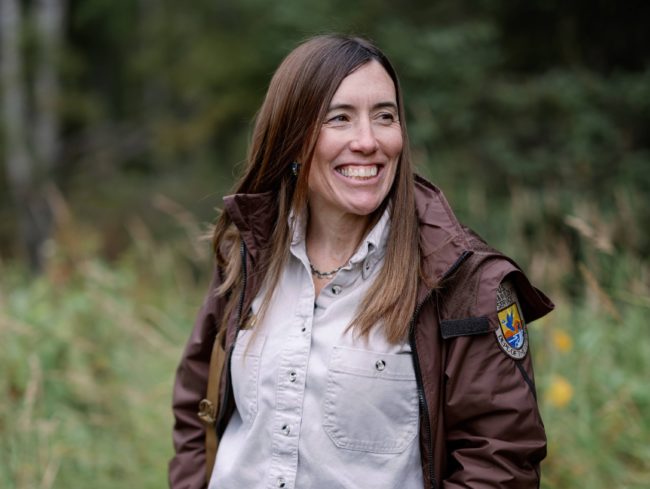
Kris Inman, Kenai National Wildlife Refuge Supervisory Wildlife Biologist

This meeting’s presentations were recorded.  Watch below:

Christina Nelson, Selawik National Wildlife Refuge:
Intro to Selawik

Kris Inman, Kenai National Wildlife Refuge:
Stewarding the Kenai National Wildlife Refuge

(This recording has been edited to include the wolverine footage that wouldn’t play during Kris’ presentation.)


This is a time of unprecedented, profound, and rapid human-driven environmental change.  In her presentation, Kris will share a few of the Kenai biology team’s many projects that give a big-picture view of how wildlife populations and habitats might be changing or impacted by landscape issues like climate change and human population growth.  Changing water temperatures in salmon streams, increased traffic on the Sterling Highway, more people living and recreating around the refuge and the spread of non-native species are a few of the human caused impacts to the refuge wildlife that Kenai biologists and agency partners are addressing. 

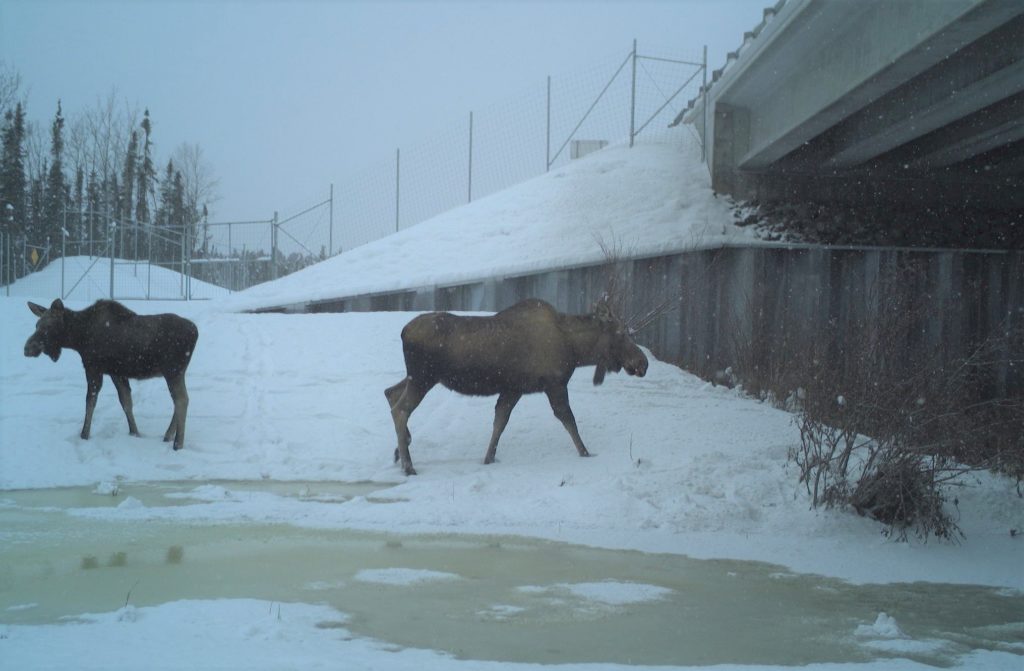
Kris will share new technology like thermal imagery to document and understand the impact of water temperature changes on our world-famous salmon rivers that sustain bears, eagles, and people. She will also share results from the Refuge’s efforts to minimize the impact of increased human presence on the Kenai including the effectiveness of Alaska’s first wildlife road crossing project to provide safe movements for wildlife across the busy Sterling Highway which splits the Refuge.  She will also highlight collaborative efforts to eradicate or control the spread of non-native invasive species like pike, elodea, white sweet clover, bird vetch, and reed canary grass that influences salmon habitat or encroach on native vegetation. In doing so, the biology team, working with refuge staff and many partners, will meet the station’s vision of stewarding the lands and waters with an eye to the future, so the Refuge’s diverse and abundant wildlife remain for the enjoyment and well-being of generations to come. 

Moose using the new Sterling Highway wildlife underpasses.  Fences funnel wildlife to the underpasses of this increasingly busy highway.   Kris will discuss what the refuge has learned about the effectiveness of this project.

Kris Inman recently joined the Kenai National Wildlife Refuge as the Supervisory Wildlife Biologist. Before coming to Alaska, she worked on a wide range of wildlife research and inventory and monitoring projects, from the little-known Tomah mayfly and freshwater mussels to more charismatic species like wolves, bears, and wolverine. Kris received a Bachelor of Science degree from the University of Maine and a Master of Science degree from Virginia Polytechnic Institute and State University. 

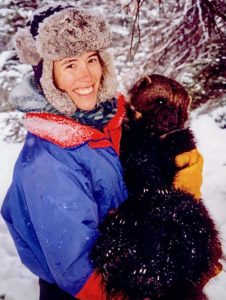
She spent the last twenty years living, working, and raising her family in the lands outside of Yellowstone National Park, where she and her husband co-led a collaborative wolverine research study for the Wildlife Conservation Society. This project eventually would contribute the largest body of science on wolverines in the lower 48 and would identify the biggest conservation needs: to restore, connect, and monitor wolverines across their current and historic range.

From there, Kris switched from researcher to implementor. She worked with broad stakeholder groups in SW Montana to apply wolverine science in a region critical to wildlife connectivity for not only wolverines but also migratory ungulates and recovered grizzly bear and wolf populations. As the Coordinator of Strategic Partnerships and Engagement for the Wildlife Conservation Society, she brought stakeholders together to develop tools to reduce negative human-wildlife interactions. She also explored and implemented natural climate adaptation strategies like beaver mimicry to improve private working ranchlands’ economic and ecological sustainability as critical corridors to public lands.

Kris holding a wolverine!

In 2018, the Disney Conservation Fund named Kris a Disney Conservation Hero for her contributions to science and engaging and empowering communities to take science to action. Kris was also selected as an American Association for the Advancement of Science IF/THEN® Ambassador, a network of 125 women STEM (Science, Technology, Engineering and Math) professionals from around the country who share their professional stories so young girls see that a career in STEM is possible. 

 Kris sees the Kenai Peninsula as similar to the Greater Yellowstone Area in its global significance as a large, intact, wild landscape, diverse in its wildlife while grappling with the challenges of rapidly growing nearby communities seeking solitude and world-renowned outdoor experiences. 

Kris is glad to be a part of the Kenai Refuge and the larger refuge team in Alaska. She works with colleagues who recognize that conserving these great places will take a new future-oriented approach to conservation, and they are committed to developing solutions to meet the challenges of this century. At the same time, this work recognizes that people are part of nature and not separate from it.  Seeing people in this light, we no longer just identify people as the problem but also the solution.