By Marilyn Sigman, Friends President
My first trip to the Arctic Refuge was in 1981. I was a fledgling wildlife biologist, having completed a Master’s degree in wildlife management at the University of Alaska in Fairbanks and snagged my first permanent job as a habitat biologist. I traveled up and down the Haul Road corridor looking for opportunities to protect habitat in advance of a gas pipeline whose construction seemed imminent then. When John Adams, the Director of the Northern Alaska Environmental Center, wasn’t able to lead a planned trip to the Kongakut River in the Arctic Refuge, I jumped at the chance to volunteer.
Two women who had signed up for the trip had been looking forward to being led by one of Alaska’s more dashing and musical environmentalists and were not impressed by my last-minute substitution, especially when I screamed during the bear safety lecture I was giving because I spotted a spider crawling on my shotgun. The gear we ended up with was missing a few things like tent poles and all of the parts for most of the stoves. Fortunately for me, a fanatic fisherman in our group caught and cooked up fresh grayling each morning while I was struggling to get out of my sleeping bag to serve an expected breakfast. Fortunately for us all, the July weather was gloriously sunny. We wandered across the braided floodplain and along ridges amid blooming wildflowers and the calls of birds. As advertised and hoped for, clusters of the Porcupine Caribou – spiky bulls and cows with their newborn calves – came streaming by our tents on the gravel bar, their joints clicking. A pack of wolves passed by one day.
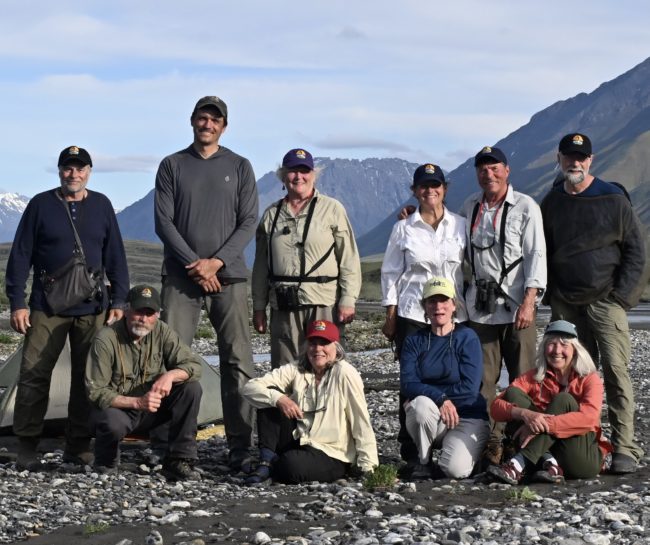
I returned to the Kongakut 40 years later, again in July. This time, I was the one being guided, required only to bring five layers of clothes and my hiking gear. The migration of the Porcupine Herd was again the spectacular wildlife event being promised. We flew over the trails that caribou had ground deep into the tundra, and saw groups clustered like ants on the few remaining snow patches.
By then, I had seen many Alaskan places “before” and “after” they were changed by development or a warming climate. I had flown from Kaktovik to Prudhoe Bay in January and seen how Prudhoe Bay had mushroomed in all directions. The Arctic night was lit up by large trucks plying a spiderweb of ice roads that began just past the western border of the Refuge. I had been fighting for all of those decades to prevent the Arctic Coastal Plain of the Refuge from becoming part of the “afterness”, engulfed in the spiderweb. There was talk, once again, about building a gas pipeline.
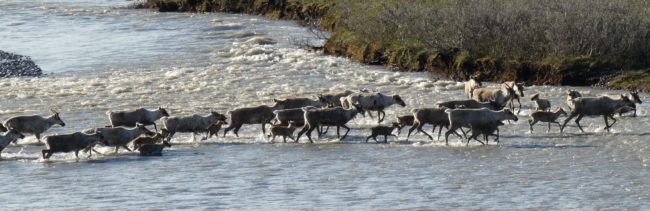
We camped again on a gravel bar at the edge of the foothills, and I spent a few more nights falling asleep to the clicks of caribou moving relentlessly. I watched the drama of their crossing the braided rivers at a near-frantic pace. Calves got swept away; cows searched and called for them; even the largest bulls struggled up steep banks. But still they came and moved on, leaving me behind in a more lonesome landscape. I saw grizzlies and wolves, a lone muskox, tufts of qiviut in the willows, a warble fly close up, and a few Arctic birds.
There was a moment when I paused on a hillside above the vast open valley as the others in my group continued their exploration upward onto a ridge in the sunshine and flowery summer exuberance. More than a thousand caribou had just crossed the river and a couple of left-behind yearlings were wandering below me. The ground was intricately patterned. The lichens were dissolving the rocks. Caribou antlers and small mammal bones were slowly crumbling into dust. I felt the lightness of my four decades against the weight of a deep “before.”
Photo Above
Caribou crossing the Aichilik River on my 2022 trip to the Arctic Refuge. PC Marilyn Sigman